
About / Research Vision
I'm a PhD candidate in ECE at UCLA, advised by Prof. Mani Srivastava. My research focuses on systems and infrastructure for deploying and operating machine learning and foundation models across heterogeneous and distributed computing environments, with applications in autonomous and cyber-physical systems. I build systems that use application requirements, together with workload and resource constraints, to guide how models are placed, served, and orchestrated. My work spans three thrusts:
- Foundation-model serving and production ML infrastructure. FMplex [1] brings virtualization to model serving, allowing customized tasks to share a foundation model while maintaining their own extensions and isolation. FMTK [7] makes foundation-model pipelines composable from reusable components. At NVIDIA, I built APOLLO, an agentic system for finding and validating optimizations in the pipeline behind Alpamayo, NVIDIA's autonomous-driving foundation model. It is now used across the team and broader organization.
- Task-aware placement and orchestration. My work on splitting perception and control pipelines across device, edge, and cloud shows that deployment decisions should follow task objectives and system conditions [9][10], and that cloud execution can outperform local inference even for real-time control [8]. I am currently extending this direction to stateful foundation-model pipelines that adapt at runtime.
- Extensible evaluation and deployment infrastructure. CADET [5] integrates driving simulation, network emulation, and heterogeneous hardware to evaluate deployment decisions against application-level outcomes. HoliBench [4] and CREST [3] apply the same extensible approach to cross-platform foundation-model characterization and hardware-in-the-loop model design, allowing new devices, models, and backends to plug into a common workflow.
Before my PhD, I spent about three years at Amazon building Amazon Sidewalk, a low-power IoT network now running on millions of devices, and worked on automotive wireless systems at Bosch Research and Carnegie Mellon University. I expect to graduate in March 2027 and am looking for ML infrastructure and research engineering roles.
On-going Projects
FM Orchestration
Temporal state encoders coupled with MPC or an RL policy as the planning layer, for closed-loop orchestration of foundation model pipelines across device-edge-cloud continua
Real-Time CPS Application Taxonomy for FM Deployment
A unified deployment characterization across the perception-control-action spectrum of real-time CPS applications, including passive perception, open-loop response, and closed-loop control, with empirical evaluation on the CADET testbed and network sensitivity analysis identifying where deployment recommendations shift between device, edge, and cloud
Industry Experience
NVIDIA
Systems Software Engineering Intern · ML Infra (Alpamayo) · Summer 2026
Built APOLLO, an agentic system for systematically investigating and optimizing distributed autonomous driving pipelines, delivering validated speedups of up to 8× and resource savings of up to 40%.
Impact & Achievements:
Designed and implemented APOLLO (Agentic Pipeline Optimization and Learning Loop Orchestrator) for Alpamayo, which reconstructs distributed executions, characterizes bottlenecks, and investigates optimization hypotheses in parallel with specialized agentic stacks. Independent checks verify correctness and measurement validity before any change reaches engineering/developer approval, with built-in safeguards for access control and human oversight.
- Redesigned batching for a labeling stage of the Alpamayo data release pipeline, cutting its CPU cost by ~70% at full output parity. Projected capacity savings of up to 71,000 CPU-hours per week based on measured workloads.
- Reduced CPU usage by ~40% and achieved speedups of up to ~8× across investigated pipeline components, validated via controlled experiments on runtime, resource consumption, and output parity.

Amazon Lab126
Embedded Software Engineer · 2019 - 2021
Designed Amazon Sidewalk IoT network from the ground up, enabling seamless connectivity for millions of Ring and Amazon devices across the 900 MHz spectrum with optimized low-power embedded systems firmware.
Impact & Achievements:
- Worked on the development of Amazon Sidewalk, a large-scale IoT network that now powers connectivity for Amazon, Ring, and third-party devices, reaching millions of households nationwide.
- Co-engineered a custom 900 MHz communication protocol optimized for ultra-low-power devices, balancing throughput, range, and battery efficiency to ensure seamless operation across diverse deployment scenarios.
- Drove improvement in flash memory efficiency by designing an end-to-end configuration management system with abstraction layers that intelligently moderated application-layer flash access.
- Built low-latency firmware bridging hardware and software layers, independently resolving critical production issues, and mentoring cross-functional teams to meet aggressive product launch timelines.
Bosch LLC, R&D Department
Wireless Systems Intern · 2018
Hardware-software co-design for ultra-precise vehicle localization achieving 30cm accuracy using Ultra-Wide Band technology, revolutionizing the keyless entry experience for next-generation vehicles.
Impact & Achievements:
- Collaborated with Bosch's Wireless Connectivity Group to implement the Perfectly Keyless project, a passive entry system designed to eliminate traditional car keys and provide a frictionless user experience.
- Engineered hardware and modeled advanced localization algorithms using Ultra-Wide Band (UWB) nodes strategically positioned on vehicles, achieving 30cm positioning accuracy.
Carnegie Mellon University
Graduate Research Assistant · 2018
Conducted cutting-edge research in automotive security, wireless systems, and network optimization across three major projects sponsored by Ford R&D, Argonne National Labs, and published in IEEE JSAC.
Ford R&D Sponsored
PEPS Car Security: Passive Keyless Entry Vulnerability Analysis
Served as Principal Investigator exposing critical vulnerabilities in passive keyless entry systems. Demonstrated man-in-the-middle attacks using Software-Defined Radios over 300ft range, delivering actionable security recommendations to Ford R&D that influenced next-generation vehicle authentication protocols.
IEEE JSAC 2019
Admission Control for Real-Time Interactive Video Sessions
Devised novel admission control algorithm to manage congestion and allocate resources for interactive video sessions. Designed and implemented WiFi (802.11g) testbed demonstrating 47% throughput improvement over traditional routers. Published in IEEE JSAC 2019 Special Issue on Multimedia Economics.
Argonne National Labs Sponsored
DSRC/WAVE Stack for V2V Communication Security
Developed open-source implementation of DSRC/WAVE stack on BladeRF (SDR) to emulate vehicle-to-vehicle communications. Engineered complete V2V information exchange infrastructure and analyzed security vulnerabilities in authentication mechanisms.
Selected Publications
TrustBench: Bridging Generalizable Metrics and Domain-Specific Evaluation for Trust in LLMs
FMTK: A Modular Toolkit for Composable Time Series Foundation Model Pipelines
Towards a Performance-Driven Device-Edge-Cloud Relationship
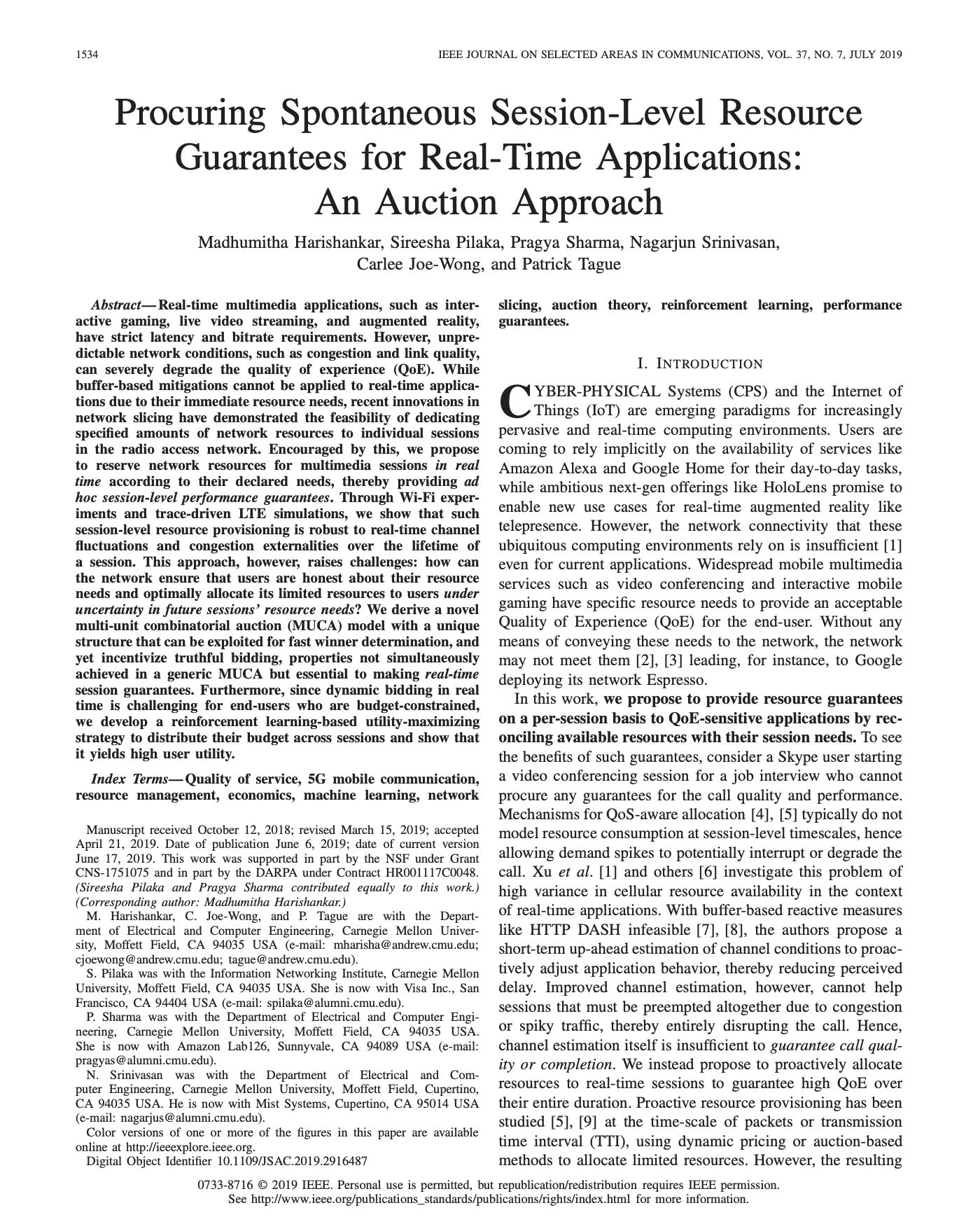
Procuring Spontaneous Session-Level Resource Guarantees for Real-Time Applications: An Auction Approach
Teaching
- [UCLA] Internet Customer Analytics by Prof. Sean Brüggemann.
- [UCLA] Forecasting and Time Series by Prof. William Yu.
- [UCLA] Logic Design of Digital Systems by Prof. Mani Srivastava.
- [UCLA] Mathematics for Life Sciences by Prof. Jane Shevstov.
- [CMU] Wireless Networks and Applications by Prof. Peter Steenkiste
Service
- Publication Chair, FMSys'26 — 3rd International Workshop on Foundation Models for Cyber-Physical Systems & Internet of Things, co-located with CPS-IoT Week 2026, Saint-Malo, France.
- Mentored 50+ undergraduate and graduate students for research projects and tech industry.
- Mentor, The Women of Color Project.
- Graduate Instructor, Los Angeles Computing Circle (CS Bootcamp 2022, 2023, 2024).
- Software Engineering Mentor, Amazon Mentorship Program.
- Head, Women in ECE (WinECE), Carnegie Mellon University, Silicon Valley.
- Campus Ambassador, Carnegie Mellon University, Silicon Valley.
- Program Representative, Student Council, ECE batch of 2017, VIT University.
Contact
Email: pragyasharma@ucla.edu · GitHub: @sharma-pragya